
Contents
- 🏛️ What is Ancient Rome?
- 🗺️ Geographic Scope & Timeline
- 👑 Key Periods: Kingdom, Republic, Empire
- ⚔️ Military Might & Expansion
- 🏛️ Governance & Law
- 🗣️ Language & Culture
- 🏗️ Engineering & Architecture
- ✝️ Religion & Philosophy
- 📉 Decline & Fall
- 💡 Legacy & Influence
- ⭐ Visitor Ratings & Reviews
- 🚀 Getting Started with Ancient Rome
- Frequently Asked Questions
- Related Topics
Overview
Ancient Rome refers to the civilization that flourished in and around the Italian peninsula, beginning with the legendary founding of the city of Rome in the 8th century BC and extending through the collapse of the Western Roman Empire in the 5th century AD. This vast historical period is not a monolithic entity but a dynamic evolution, encompassing distinct phases of monarchy, republicanism, and imperial rule. It's the bedrock upon which much of Western civilization, from law and language to governance and architecture, was built. Understanding ancient Rome means grappling with its immense scale, its complex social structures, and its enduring impact on the world we inhabit today.
🗺️ Geographic Scope & Timeline
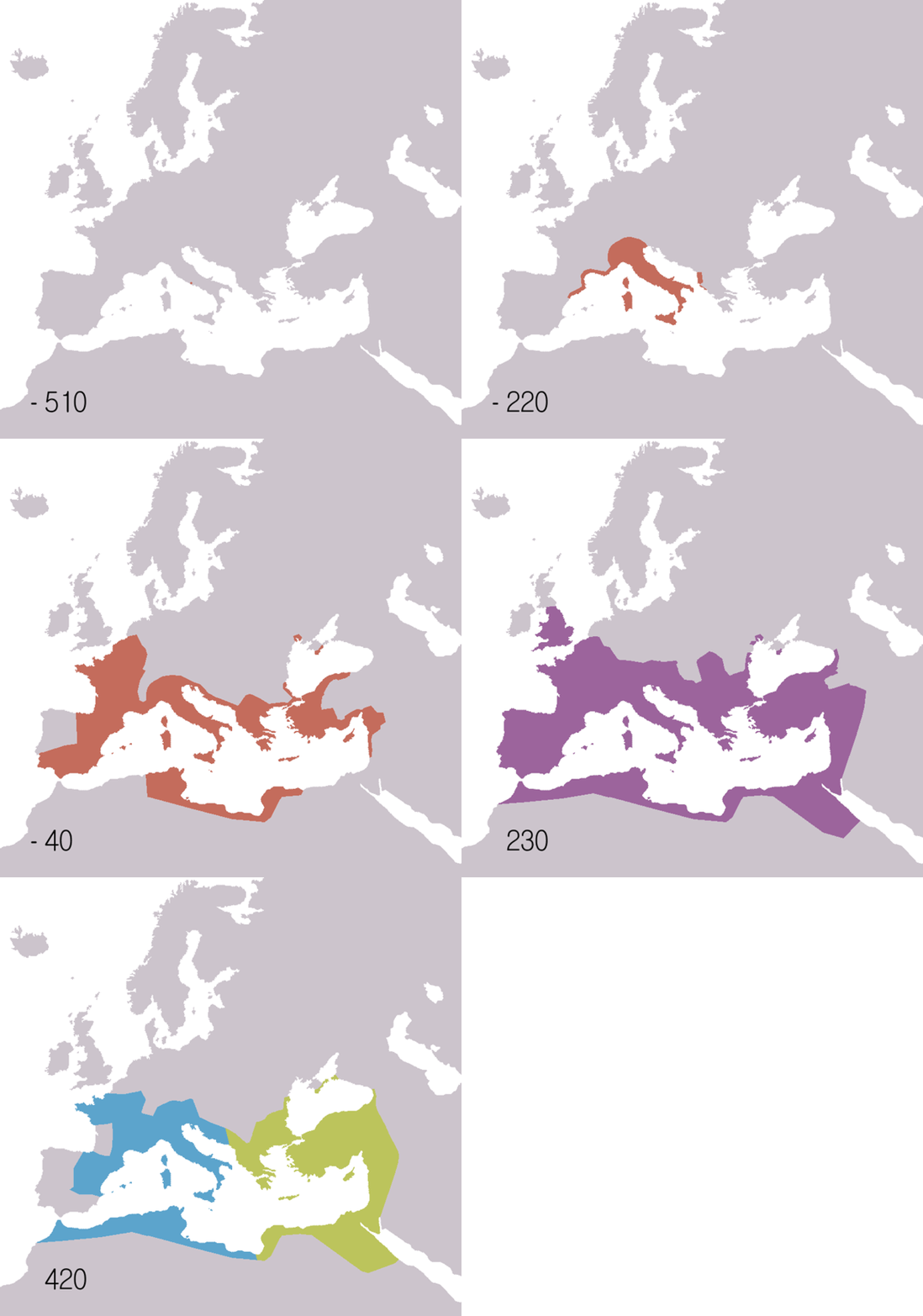
The heart of ancient Rome was the city itself, situated on the Tiber River in central Italy. However, its influence and dominion expanded dramatically over centuries, eventually encompassing the entire Mediterranean basin, large swathes of Europe, North Africa, and the Near East. The timeline is typically divided into three major epochs: the Roman Kingdom (c. 753–509 BC), the Roman Republic (509–27 BC), and the Roman Empire (27 BC–476 AD for the West). Each period witnessed significant shifts in political power, social organization, and territorial control, making the study of its geography and chronology crucial for comprehension.
👑 Key Periods: Kingdom, Republic, Empire
The journey of Rome begins with the Roman Kingdom, a period shrouded in legend, where seven kings are said to have ruled. This was followed by the Roman Republic, a more complex system characterized by elected officials, a powerful Senate, and a sophisticated legal framework that emphasized civic duty and the rule of law. The transition to the Roman Empire under Augustus marked a new era of centralized authority, vast imperial expansion, and unprecedented cultural achievements, though it also sowed the seeds of future internal strife and eventual division. Each of these political systems offers unique insights into Roman development.
⚔️ Military Might & Expansion
The Roman military machine was legendary, a key driver of its expansion and a cornerstone of its power. From the disciplined legions to innovative siege warfare, Roman military prowess allowed it to conquer vast territories and maintain control over its sprawling empire. The development of military tactics, engineering feats like road construction for troop movement, and the organization of the army were crucial elements. Understanding the Roman army is essential to grasping how Rome achieved and maintained its dominance for so long, often clashing with formidable adversaries like the Carthaginians during the Punic Wars.
🏛️ Governance & Law
Roman governance and law represent one of its most profound legacies. The Republic's intricate system of checks and balances, the Senate's enduring influence, and the development of Roman law—a codified system that influenced legal traditions worldwide—are testaments to their organizational genius. Concepts like citizenship, property rights, and due process, though evolving, were central. The transition to imperial rule saw a concentration of power, but the administrative structures and legal principles established during the Republic continued to shape the empire's functioning, impacting everything from provincial administration to the lives of ordinary citizens.
🗣️ Language & Culture
Latin, the language of the Romans, became the lingua franca of the Western Empire and the direct ancestor of the Romance languages (Italian, French, Spanish, Portuguese, Romanian). Roman literature, philosophy, and rhetoric, heavily influenced by Greek traditions, produced enduring works by figures like Virgil, Cicero, and Seneca. Roman theatre, poetry, and historical writing offer invaluable windows into their society, values, and intellectual life, shaping Western literary and philosophical traditions for millennia.
🏗️ Engineering & Architecture
The Romans were master engineers and builders, leaving behind monumental structures that still stand today. From the Colosseum and the Pantheon to aqueducts, roads, and public baths, their architectural and engineering achievements were unparalleled in the ancient world. These structures not only served practical purposes—providing water, facilitating transport, and offering entertainment—but also symbolized Roman power, ingenuity, and civic pride. Their innovations in concrete, arch construction, and urban planning set standards for centuries to come.
✝️ Religion & Philosophy
The religious landscape of ancient Rome was complex, evolving from early animistic beliefs and the worship of Jupiter and other Olympian deities to the eventual adoption and spread of Christianity. Roman religion was often intertwined with the state, with emperors sometimes deified. Philosophical schools like Stoicism and Epicureanism also found fertile ground, influencing Roman thought and ethics. The eventual rise of Christianity within the empire marked a profound spiritual and cultural transformation, ultimately becoming the dominant religion of the late Roman world.
📉 Decline & Fall
The decline and fall of the Western Roman Empire in 476 AD was not a single event but a protracted process driven by a confluence of factors. These included internal political instability, economic challenges, overstretched military resources, barbarian invasions, and social unrest. The division of the empire into Western and Eastern halves further weakened the West. While the Western Empire dissolved, the Eastern Roman Empire, later known as the Byzantine Empire, continued for another thousand years, preserving many Roman traditions and institutions.
💡 Legacy & Influence
The legacy of ancient Rome is immeasurable, permeating nearly every aspect of modern Western civilization. Its legal systems form the basis of many contemporary legal codes, its languages evolved into major world tongues, its architectural principles continue to inspire, and its political concepts—republic, senate, empire—remain part of our discourse. The very idea of a unified Europe owes much to the memory of Roman administration and infrastructure. The study of Roman history is, in essence, a study of our own roots and the enduring power of ideas and institutions.
⭐ Visitor Ratings & Reviews
Visitors consistently rate the historical significance and cultural impact of ancient Rome as exceptionally high, often citing the sheer scale of its achievements and the depth of its influence. Many express awe at the surviving architectural marvels like the Pantheon and the Forum. While direct 'ratings' are impossible for a historical period, scholarly consensus places its importance in the highest tier of world civilizations. Its enduring appeal is reflected in the millions who visit Rome annually to walk in its footsteps.
🚀 Getting Started with Ancient Rome
To begin exploring ancient Rome, start with a broad overview of its major periods: the Kingdom, Republic, and Empire. Consider focusing on a specific aspect that sparks your interest, whether it's the Punic Wars, the life of Julius Caesar, or the construction of the aqueducts. Many excellent books and documentaries are available, and visiting Rome itself offers an unparalleled immersive experience. Engaging with primary sources, even in translation, can provide direct insight into the Roman world.
Key Facts
- Year
- 753 BCE - 476 CE (Western Empire)
- Origin
- Italy
- Category
- History
- Type
- Historical Period
Frequently Asked Questions
What is the difference between the Roman Republic and the Roman Empire?
The Roman Republic (509–27 BC) was characterized by a system of elected officials and a powerful Senate, emphasizing shared governance. The Roman Empire (27 BC–476 AD in the West) began with Augustus and featured a more centralized, autocratic rule under an emperor, though republican institutions often persisted in form. The transition marked a significant shift in political power and governance structure.
When did Ancient Rome officially end?
The traditional date for the end of Ancient Rome is September 4, 476 AD, when the last Western Roman Emperor, Romulus Augustulus, was deposed by the Germanic chieftain Odoacer. However, the Eastern Roman Empire, or Byzantine Empire, continued for nearly another thousand years, preserving Roman traditions and institutions.
What were the most significant military achievements of Ancient Rome?
The Roman military was renowned for its disciplined legions, effective tactics, and engineering prowess. Key achievements include the conquest of the Mediterranean basin during the Punic Wars, the expansion under emperors like Trajan, and the construction of extensive fortifications like Hadrian's Wall. Their ability to adapt and innovate in warfare was crucial to their success.
How did Roman law influence modern legal systems?
Roman law, particularly the Corpus Juris Civilis compiled under Justinian I, provided foundational principles for many modern legal systems, especially in continental Europe. Concepts such as natural law, equity, and codified statutes, along with specific legal doctrines concerning property, contracts, and persons, were heavily influenced by Roman jurisprudence.
What is the most famous surviving Roman structure?
While many structures are famous, the Colosseum in Rome is arguably the most iconic symbol of Roman engineering and entertainment. Other highly significant surviving structures include the Pantheon with its remarkable dome, the Roman Forum, and numerous aqueducts and roads scattered across the former empire.
Did Romans speak only Latin?
Latin was the official language of administration, law, and literature in the Western Roman Empire. However, in the Eastern Mediterranean, Greek remained the dominant language of culture and commerce. Regional dialects and other languages were also spoken throughout the vast empire, reflecting its diverse populations.